Designing a Workspace That Makes You Want to Work
Your workspace is either working for you or against you. Lighting temperature, natural light, plants, color psychology, and the minimalism vs. warmth balance — here's how to design a home office that actually makes you want to sit down and do the work.
Your Office Is a User Interface. Have You Designed It?
Every morning you sit down at a desk someone else chose, in a corner someone else suggested, under lighting you've never adjusted.
And then you wonder why it's hard to focus.
Your workspace isn't neutral.
It's either pulling you into deep work — or quietly working against you. The light in the room affects your cortisol. The color of your walls influences your mood. The clutter on your desk competes for your attention before you've even opened a browser tab.
The good news: you don't need a renovation.
You need intention.
Why Environment Shapes Output
There's a principle in software design called the "pit of success" — the idea that good architecture makes doing the right thing easy and doing the wrong thing hard.
Your workspace is the same.
When your environment is designed well, focus happens almost automatically. When it isn't, you're fighting friction you can't even see.
Interior designers have known this for decades. What's newer is the research backing it up — studies on lighting and cognitive performance, on plant exposure and stress reduction, on color temperature and alertness.
Remote workers who design their workspace intentionally aren't just making things pretty.
They're engineering conditions for better thinking.
The Five Elements That Actually Matter
1. Lighting Temperature
This is the single highest-leverage change most home workers can make.
Light temperature is measured in Kelvins (K) and falls on a spectrum from warm amber to cool blue-white:
- 2700–3000K — Warm, amber light. Relaxing. Great for evenings and living spaces. Bad for focus.
- 4000–4500K — Neutral white. Balanced. A solid all-day desk light.
- 5000–6500K — Cool, daylight-spectrum light. Energizing. Best for deep work, reading, and alertness.
Most people have warm bulbs in their home office because they came with the house.
That's a problem.
Warm light signals your brain that the day is winding down — it suppresses the alertness cues your nervous system needs to focus. If you're dragging every afternoon, your lighting might be part of the cause.
The fix: Swap your desk lamp or overhead bulb to a 5000K daylight bulb for work hours. Step down to 3000K in the evening to support your wind-down.
Even better: get a desk lamp with adjustable color temperature so you can shift throughout the day.
2. Natural Light Placement
Natural light isn't just about brightness. It's about direction.
The rule most people get wrong: Don't sit facing a window.
It seems counterintuitive. You want the light. But direct light facing you creates glare on your screen and causes your pupils to contract — meaning you're actually seeing your monitor worse, not better.
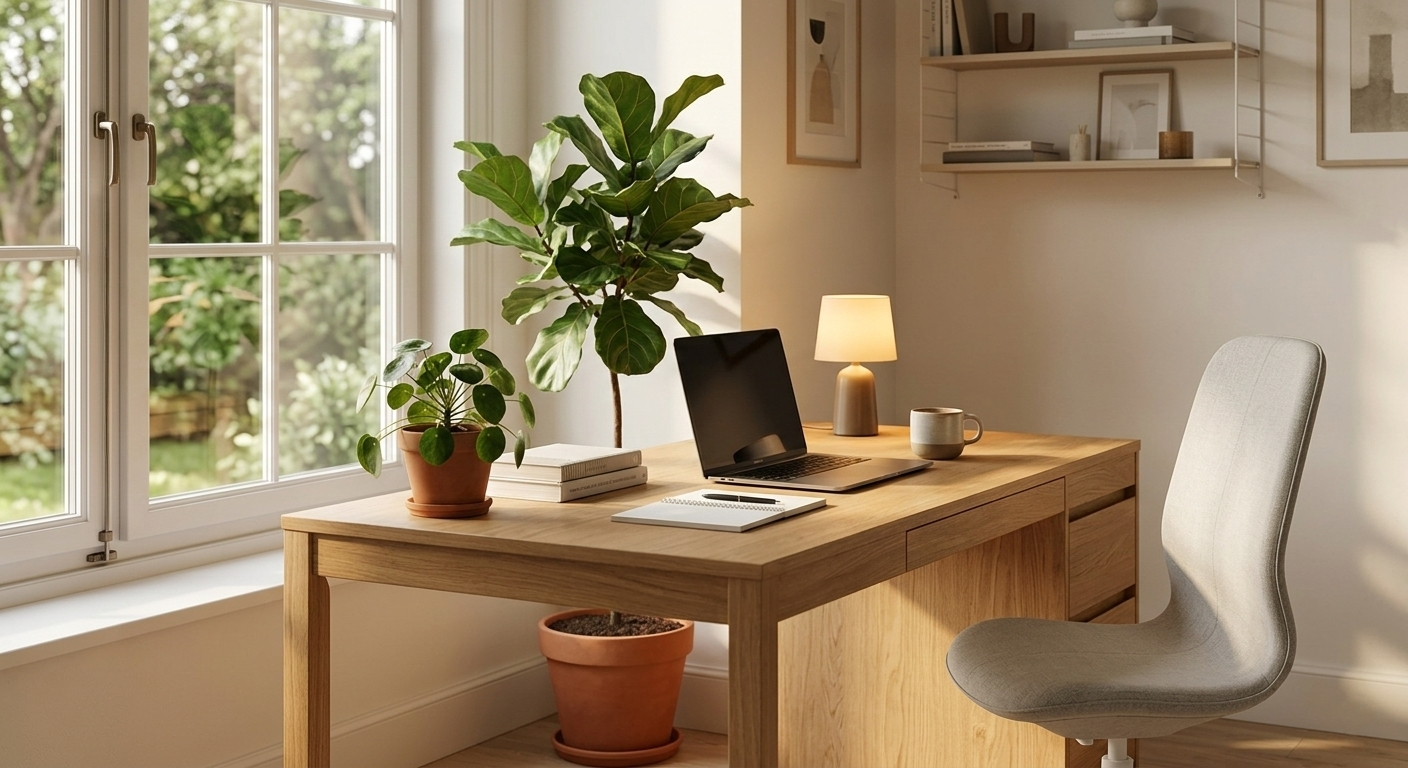
The better placement: Window to your left or right.
Side lighting provides even illumination across your workspace without screen glare. It also keeps your face well-lit for video calls without washing you out.
If your room layout doesn't allow side lighting, a sheer curtain to diffuse direct sunlight is your next best option.
Bonus: Exposure to natural light before noon helps anchor your circadian rhythm. Even 20–30 minutes of morning light — at your desk, by an open window, or outside — has measurable effects on energy and sleep quality later that night.
3. Minimalism vs. Warmth
This is where most workspace advice goes wrong.
The internet is full of two camps:
The minimalists: All-white desk. Nothing on the surface. Floating shelves with exactly three objects. Clean, but cold.
The maximalists: Gallery walls. Trinkets. Layered rugs. Warm and personal, but visually noisy.
Both taken to their extreme create problems.
A sterile, empty desk can feel clinical and demotivating — fine for processing tasks, but poor for creative work. A cluttered, warm space feels cozy until you're trying to focus and every object is silently demanding attention.
The answer is layered minimalism.
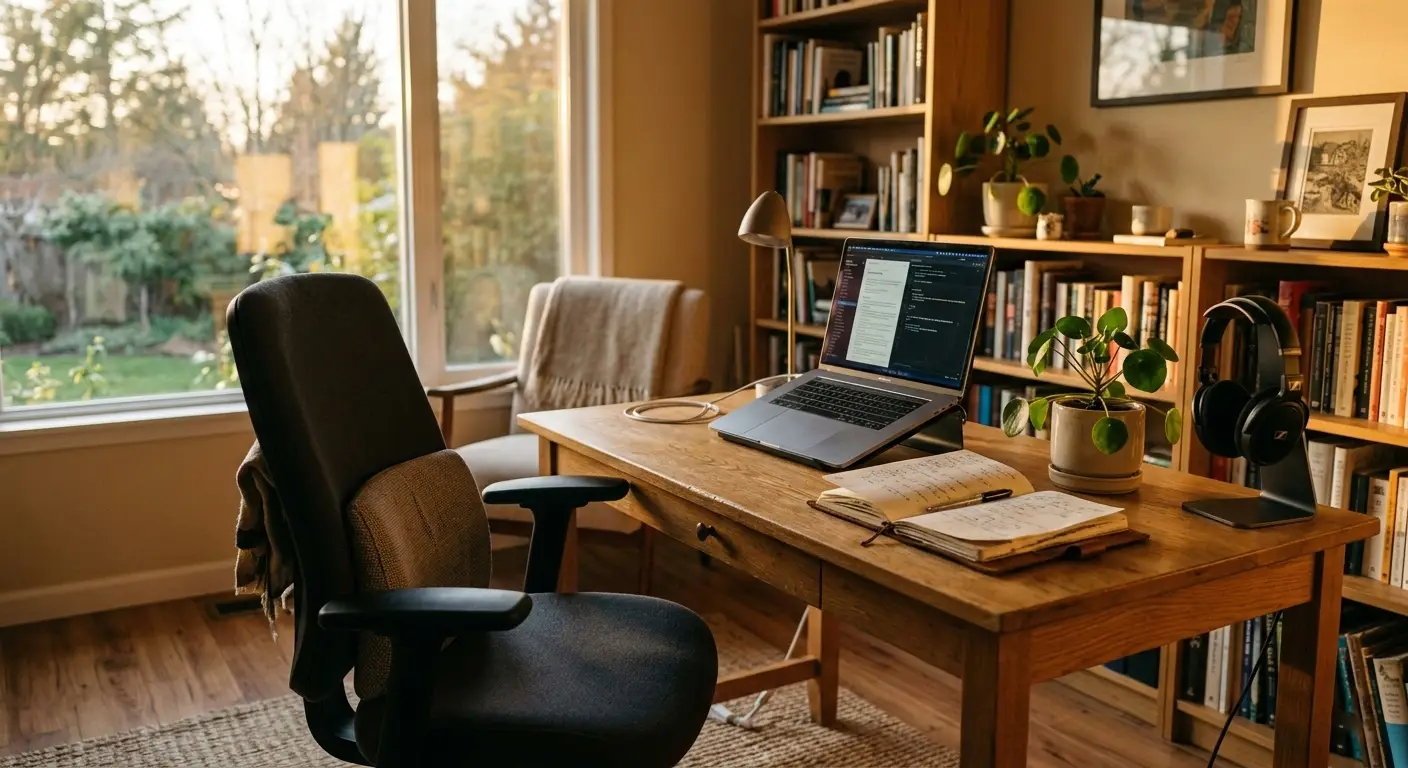
Start with a clear surface — nothing on the desk that doesn't serve the work. Then add one or two intentional warm elements: a ceramic mug you love, a small lamp with a warm base, a physical object with meaning.
The goal is a space that feels like yours without overwhelming you.
A good test: sit at your desk and notice what your eyes drift to. If they land on something that gives you a small hit of pleasure — a plant, a photo, a satisfying lamp — that's a warm element doing its job. If they land on a pile of papers or a cable mess, that's visual noise you're paying a cognitive tax on every day.
4. Plants
Plants in a workspace aren't decoration.
They're functional.
Research has consistently shown that having live plants in a workspace:
- Reduces perceived stress
- Lowers physiological markers of anxiety
- Improves air quality (modestly, but measurably)
- Increases reported feelings of well-being and calm
For remote workers who spend 8+ hours in the same room, this matters more than it does in an office you occasionally visit.
The practical guide:
You don't need a greenhouse. You need one or two plants that won't die.
Best options for low-maintenance desk plants:
- Pothos — Thrives in indirect light, nearly unkillable, trails beautifully off a shelf
- Snake plant — Tolerates low light and irregular watering, sculptural and upright
- ZZ plant — Basically indestructible, deep green, modern-looking
- Peace lily — Tolerates low light, flowers occasionally, good for air quality
Place a plant at the edge of your sightline — not directly in front of you, but somewhere your eyes can land during a thinking pause. That brief visual rest on something living and organic is genuinely restorative.
5. Desk Color Psychology
Color affects mood.
This isn't mysticism — it's basic environmental psychology. And your desk surface, wall color, and dominant hues are doing something to you every day whether you've thought about it or not.
Here's a quick reference:
Blue and blue-green tones Promote calm, focus, and cognitive clarity. Excellent for analytical work. The reason so many tech company offices use blue-dominant palettes.
Green Reduces eye strain and feels naturally restorative — likely because of our evolutionary relationship with nature. A green accent wall or a plant-heavy setup works for long-session work.
White and light gray Clean, minimal, non-distracting. Can feel cold or uninspiring over time without warm accents to offset.
Warm wood tones Not technically a "color" in the traditional sense, but natural wood surfaces consistently test as calming and grounding. A wooden desk surface or shelf does something a white laminate doesn't.
Yellow Stimulating and creative in small doses. Overwhelming as a dominant color for a workspace. Best as an accent — a notebook, a lamp shade, a print.
Red Increases energy and heart rate. Fine for short, intense sprints. Not ideal for a space where you need sustained, calm focus.
The practical takeaway: If you have a choice in desk surface color or wall paint, lean toward cool-neutral tones (soft blue, sage green, warm white) for the dominant surfaces. Introduce warmth through objects and accents rather than walls.
Putting It Together: A Before and After Framework
Most people have some version of this workspace:
- Overhead light (warm, dim, unflattering)
- Desk facing or near a window (glare, backlight)
- Surface covered in functional clutter
- No plants
- Default desk color (whatever came with the furniture)
Here's the upgraded version — no renovation required:
- Lighting: Replace desk lamp bulb with 5000K. Add a warm secondary lamp for evenings.
- Window: Reposition desk so window is to the side, not in front. Add a sheer curtain if needed.
- Surface: Clear everything except what you use daily. Add one warm object you like looking at.
- Plants: One pothos or snake plant, positioned at the edge of your eyeline.
- Color: If repainting isn't an option, a large desk mat in a cool neutral tone can shift the color of your immediate workspace significantly.
Small changes. Cumulative impact.
Recommended Tool: Solid Wood Monitor Stand Riser

FITUEYES Natural Wood Monitor Stand Riser with Storage Organizer
A natural wood monitor riser does more than raise your screen to eye level — it anchors the warm, grounded aesthetic that makes a workspace feel intentional rather than improvised. The wood grain introduces the organic warmth that color psychology research consistently links to calm and focus, while the built-in storage shelf keeps your surface clear without hiding everything in a drawer. It is one object that addresses three sections of this post at once: desk color, minimalism, and surface clarity. A small investment that quietly changes how the whole desk feels.
As an Amazon Associate, we earn from qualifying purchases. This helps support our blog at no extra cost to you.
 Trusted marketplace
Design Is a Productivity Decision
A beautiful workspace isn't a luxury.
It's a lever.
Every hour you spend in your home office, your environment is sending signals to your brain. The light says wake up or wind down. The color says focus or relax. The clutter says there's unfinished business here.
Most remote workers optimize their hardware and their software and their workflows.
Then they sit in a dim, cluttered room and wonder why deep work feels hard.
You don't have to spend much. You don't have to redesign your entire house.
Pick one element from this post.
Change it this week.
Notice what shifts.
The best workspace isn't the most expensive one.
It's the one you actually want to sit down in.