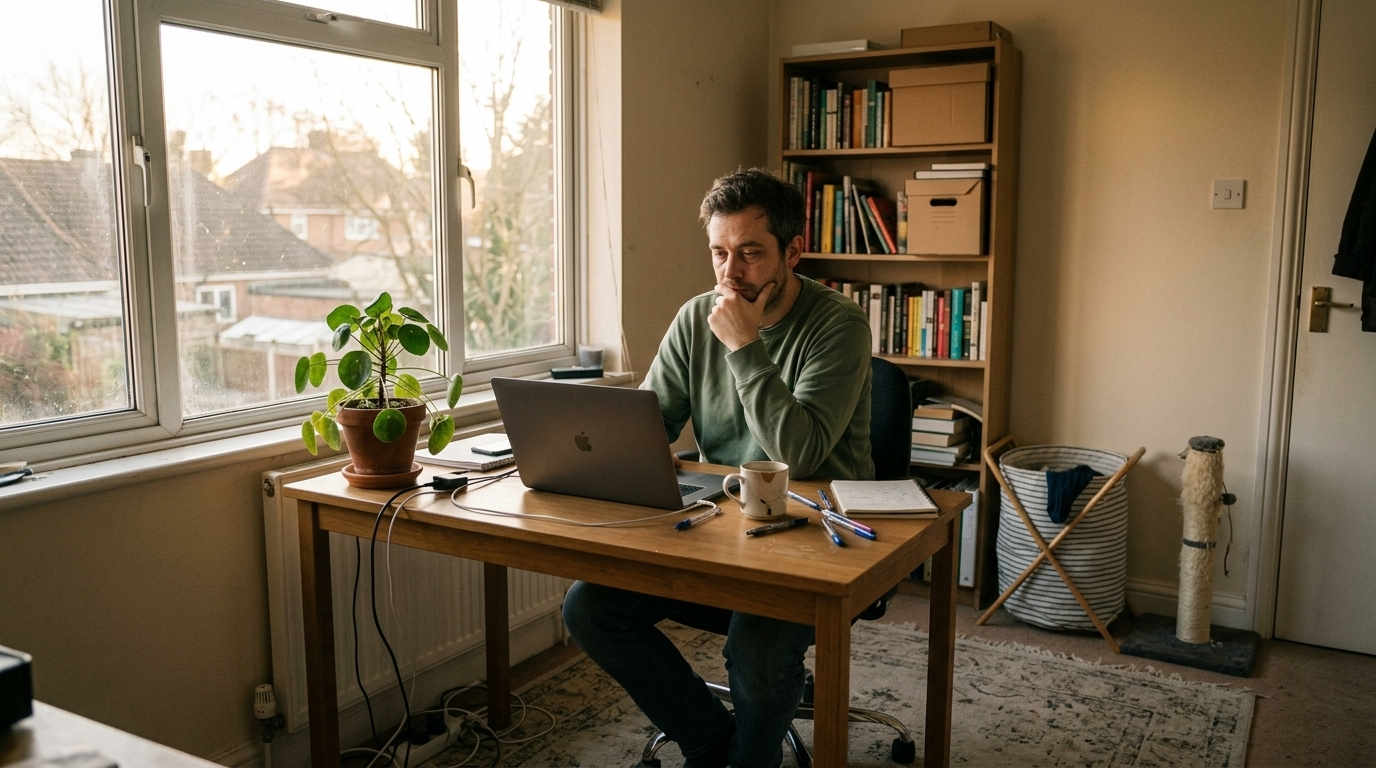
Managing the 'I'm Right Here' Guilt
When your kids are just a room away, working can feel like emotional torture. Learn how to manage Presence Guilt with practical psychology-based reframing techniques.
The Cruelest Part of Working From Home
When you worked in an office, separation was simple.
You were gone.
Your kids were home.
The roles were clean.
But WFH introduced a psychological glitch:
You are physically present
and emotionally unavailable.
You can hear them laughing. You can hear them crying. You can hear them calling your name.
And you’re just… sitting there.
This creates what I call Presence Guilt: the feeling that because you’re nearby, you should be available.
Even when you objectively can’t be.
Why Presence Guilt Hits So Hard
Presence Guilt is worse than regular working-parent guilt because:
- Your brain registers proximity as responsibility.
- Your nervous system stays in “alert mode.”
- You experience constant micro-conflict: work vs connection, over and over.
It’s not about time. It’s about perceived neglect in real time.
And the closer your kids are, the stronger it gets.
The Cognitive Error Behind the Guilt
Presence Guilt is built on a false equation:
Physical presence = emotional obligation
But this isn’t how healthy systems work.
In reality:
- Being in the house does not mean being on-duty.
- Being unavailable does not mean being uncaring.
- Working is not abandoning.
Your brain just hasn’t updated its model.
It’s still running:
“If I’m here, I should respond.”
That’s a cognitive distortion, not a moral truth.
Reframe #1: You’re Modeling, Not Neglecting
Your kids aren’t just experiencing absence.
They’re observing:
- Responsibility
- Boundaries
- Delayed gratification
- Commitment
You’re teaching:
“Important things sometimes require focus.”
That’s not harm. That’s life training.
Reframe #2: Quality Beats Fragmented Presence
Five minutes of fully-attentive connection
is worth more than two hours of distracted half-presence.
Presence Guilt pushes you toward:
- Constant micro-interruptions
- Partial attention
- Emotional depletion
Which actually leads to:
- Worse work
- Worse parenting
- More guilt
Focused blocks create better parent energy later.
Reframe #3: You’re Not Ignoring — You’re Scheduling
The guilt says:
“I’m choosing work over my kids.”
The truth is:
“I’m choosing now so I can choose them later.”
This is temporal separation, not rejection.
Future-you is still a parent. You’re just allocating time.
The Boundary That Heals Guilt
The most powerful guilt reducer isn’t mindset.
It’s predictable connection.
Kids handle absence much better when they know:
- When you’ll be back
- What will happen next
- That connection is guaranteed
Example:
“I’m working until 4. At 4:15 we’re doing Lego time.”
Now their nervous system can relax.
And so can yours.
The Nervous System Problem (Not a Moral One)
Presence Guilt isn’t about values.
It’s about chronic nervous system activation.
You’re:
- Hearing distress
- Suppressing response
- Maintaining focus
- Repeating this loop all day
That’s physiologically exhausting.
Which makes guilt feel stronger than it actually is.
You don’t need to become a better parent.
You need to reduce sensory exposure and emotional triggers.
Recommended Tool: Noise-Canceling Headphones
One of the most effective ways to reduce Presence Guilt
is to reduce sensory input.
You can’t feel responsible for what your nervous system can’t hear.

Soundcore by Anker Q20i Hybrid Active Noise Cancelling Headphones
These are one of the best “bang for your buck” noise-canceling headphones for remote work. The Soundcore Q20i delivers strong ANC, big bass, and an impressive 40-hour battery, making it easy to stay focused through long work sessions or noisy environments. With app-based EQ controls and a handy transparency mode, they’re a super practical upgrade for anyone who wants better focus without paying premium prices.
As an Amazon Associate, we earn from qualifying purchases. This helps support our blog at no extra cost to you.
 Trusted marketplace
The Presence Guilt Protocol
A simple daily system:
1. Declare Availability
Tell your kids:
- When you’re working
- When you’ll return
- What you’ll do together
2. Reduce Sensory Input
- Headphones
- Closed door
- White noise
3. Create Predictable Reconnection
- Same ritual every day
- Undistracted
- Short but consistent
4. Label the Guilt
When it shows up, name it:
“This is Presence Guilt, not a real problem.”
Naming creates psychological distance.
The Real Truth
Feeling guilty doesn’t make you a better parent.
It just makes you a more exhausted one.
Your kids don’t need:
- Constant access
- Immediate response
- Endless availability
They need:
- A regulated adult
- Clear boundaries
- Reliable connection
And ironically, the best way to give them that
is to let yourself fully work when it’s time to work.
Not because you care less.
But because you care enough to stay functional.