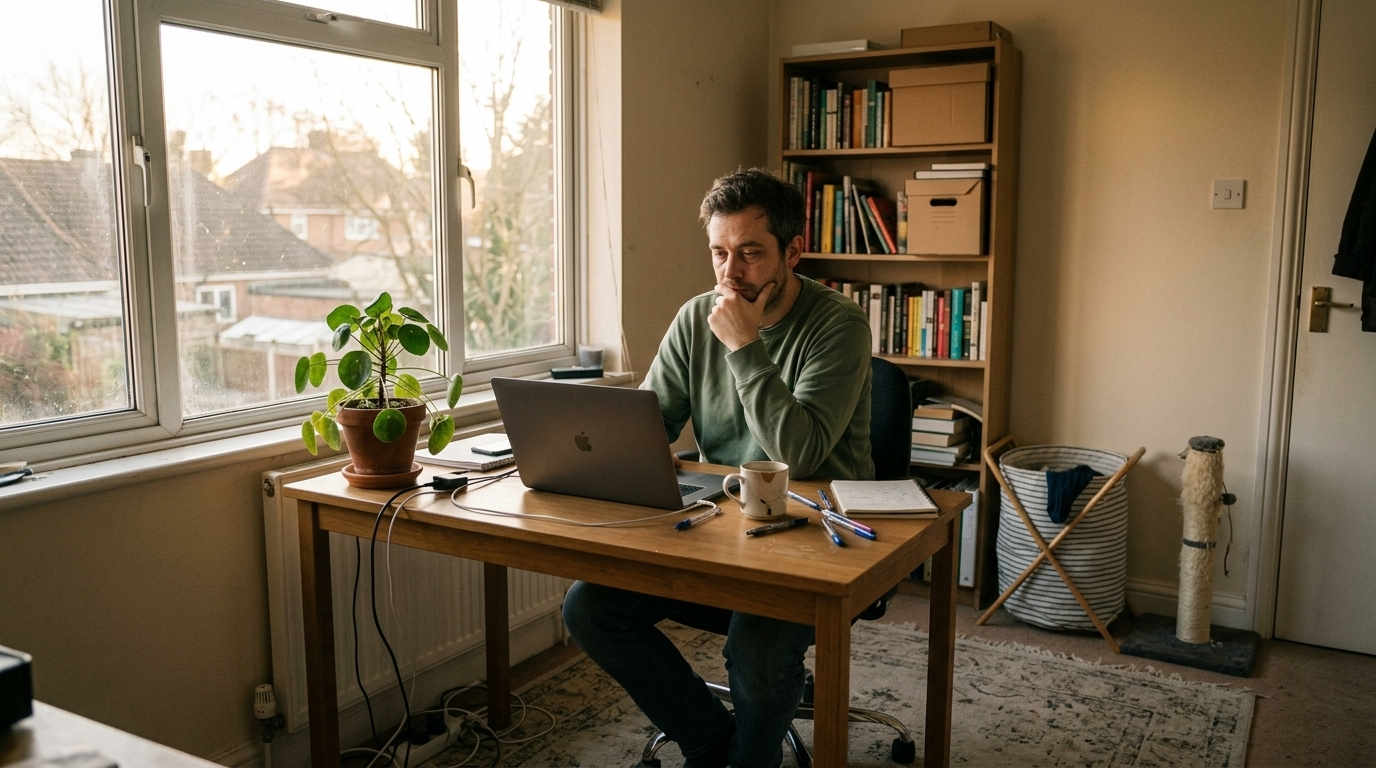
Remote Work Was Supposed to Feel Better — Why It Quietly Drains You Instead
Remote work looks flexible—but the isolation, constant notifications, and lack of boundaries quietly drain your mental energy. Here’s how I fixed it without quitting my job.
Remote Work Was Supposed to Feel Better — Why It Quietly Drains You Instead
Remote work was supposed to make life easier.
No commute.
More time with family.
Flexible schedule.
And on paper, it did.
But somewhere along the way, I started feeling off.
Not burned out.
Not overwhelmed.
Just… mentally drained all the time.
By mid-afternoon, my focus was gone.
At night, I couldn’t fully relax.
And even on “easy” days, something felt heavy.
One day I realized I had been sitting at my desk for almost 9 hours straight.
No real break.
Half-focused all day.
Jumping between code, Teams, and notifications.
I wasn’t exhausted from work.
I was exhausted from never fully stopping.
It took me a while to realize:
It wasn’t the workload.
It was how remote work was quietly rewiring my day.
1. Isolation (Even If You Live With People)
This is the one that caught me off guard.
You can be:
- Married
- Have kids
- On Zoom all day
- Active in Teams
…and still feel isolated.
Because collaboration isn’t connection.
Zoom calls are transactional.
Teams threads are task-oriented.
Standups are status updates.
You can go an entire week without a single spontaneous human interaction.
No hallway conversations.
No random lunch chats.
No shared laughter over something dumb.
Your brain notices.
Humans regulate stress through real interaction. Without it, tension doesn’t discharge the same way.
Isolation doesn’t always feel like loneliness.
Sometimes it just feels… flat.
2. Blurred Boundaries: The House Becomes the Office
When your office is three steps from your kitchen, your brain never fully clocks out.
You:
- Answer one more Teams message at 8:47 PM
- Think about a bug while brushing your teeth
- Walk past your desk and “just check something”
There’s no commute to create separation.
No transition.
So your brain stays in low-level work mode all the time.
That constant background activation?
That’s anxiety.
Not panic.
Not crisis.
Just a quiet hum you never fully escape.
3. The Always-On Teams Culture
Tools like Teams are incredible for productivity.
They’re also a psychological trap.
Green dot = available
Available = responsive
Responsive = valuable
So what do we do?
We stay semi-attentive all day.
Even when you’re trying to focus, part of your brain is listening for:
- Notification pings
- Mentions
- That red badge
This creates continuous partial attention.
You’re never fully working.
You’re never fully resting.
Just hovering in between.
And that’s exhausting.
4. Low-Grade Anxiety Is the Real Problem
Most remote workers don’t burn out dramatically.
They erode gradually.
It shows up as:
- Trouble focusing
- Irritability
- Mental fatigue by mid-afternoon
- Doom-scrolling at night
- Difficulty fully relaxing
It doesn’t feel like a breakdown.
It just feels like you’re not as sharp, patient, or present as you used to be.
And because you’re still “getting your work done,” you ignore it.
Until it compounds.
How to Fix It (Without Quitting Remote Work)
You don’t need to abandon remote work.
You need structure.
And if you’re even a little technical, you can build systems that protect your mental health instead of draining it.
1. Create Artificial Transitions
No commute? Build one.
- Take a 10-minute walk before logging in
- Change clothes after work
- Play a specific “shutdown” playlist
- Physically close and put away your laptop
Your brain needs signals.
Even small ones create separation.
2. The Red-Light “Do Not Disturb” System
This sounds simple, but it changed how my entire house behaves.
Use a smart light in your workspace:
- 🔴 Red = Deep Work / Do Not Disturb
- 🟢 Green = Available
- ⚫ Off = Not working
When the light turns red:
- My kids know I’m not available
- I stop checking notifications
- My brain shifts into protected focus
It’s more effective than any status message I’ve ever set.
Your environment should reinforce your boundaries—not fight them.
3. Automate Your Boundaries
If it relies on willpower, it will fail.
Use automation instead:
- Lights dim at the end of your workday
- Notifications mute automatically after hours
- “Work mode” disables distractions
- Break reminders trigger physically (light change, sound, etc.)
You automate deployments.
Automate your sanity too.
4. Enforced Breaks (Not Optional Ones)
Set hard constraints:
- 50-minute work blocks
- Mandatory stretch reminders
- Screen dimming triggers
- Calendar blocks for thinking time
Stack breaks with movement:
- Walk outside
- Stretch your shoulders
- Step away from screens
Even 3–5 minutes resets your nervous system.
You’re not a machine.
You’re running on a biological OS.
5. Reintroduce Real Human Interaction
This is the most important one.
Don’t wait until you feel isolated.
Schedule it.
- One in-person coffee per week
- One casual, non-work call
- One activity outside your house
Remote work removes interaction by default.
You have to add it back intentionally.
Recommended Tool: LED Desk Lamp

LED Desk Lamp for Office Home, Eye-Caring Desk Light
Reduce eye strain during long coding sessions with a flicker-free LED desk lamp. Adjustable brightness and color temperature help you shift from deep work to evening wind-down without harsh glare.
As an Amazon Associate, we earn from qualifying purchases. This helps support our blog at no extra cost to you.
 Trusted marketplace
The Shift Most Remote Workers Need
Remote work didn’t break your mental health overnight.
It slowly removed the boundaries that used to protect it.
No commute.
No separation.
No clear off switch.
So now you have to build those boundaries yourself.
Not with willpower.
With systems.
Because the same way bad systems create stress…
Good ones can give you your clarity back.